Shmintelligence – Opinions on AI

A friend of mine seems to use ChatGPT to write every message he sends out. It’s still pretty easy to spot when he has used it, and it still leaves a strange taste in my mouth. Why is a robot texting me in his place?

That strange taste is the overarching effect of AI on myself, and I don’t think anybody knows quite what to do with the feeling left over after interacting with a bot where we used to interact with a human. Especially when we know the bots are not 100% trustworthy. Not even close.

Strange feelings aside, it’s clear that AI is not going away, and the interactions with robots will accelerate because convenience overrides quality. Just like streaming overtook the CDs and LPs of the world, and we were forced to choose Spotify or A.N. Other – The net result is that I need to choose an AI platform. I need my own opinions on various options I have used, and below is the lay of the land as I see it:

  • ChatGPT – All powerful and popular, but not appealing because of the origin stories and the boardroom dramas, and because of all the lawsuits. Elon Musk teamed up with Sam Altman and that resulted in a greedy scraping Robot, and I just don’t want to use it. It just hit a billion dollars revenue a month but it is burning as much in energy and costs. Extraordinary.
  • Grok – seemingly more extreme and outlandish in its utterances, and more links with Elon with all his lawsuits and wildness. Not an X user. Not particularly interested.
  • Claude – appealing for its supposed focus on safety and transparency. I like the free version as much as I like any talking robot prompt, but commitment is expensive at USD 17 a month.
  • Gemini – already part of my Google One account subscription and works much the same way as the others for me. Appealing for me as I think Google’s lead in search and deep history in creating AI will give it advantages long into the future. I am going to choose this one not because of any difference in quality that I have had with interactions, but because of the bundle.

My point about bundles above suggests to me that the tech is a commodity already. Sure, there are benchmarks to measure performance, but do we really see those differences in our daily use? I certainly can’t tell. But hey what do I know? I still write my own blog posts. It feels good to have come up with an opinion on the tools I have used so far, even if they have been foisted upon me without much of a say on my part. What a strange world it is.

Happy Thursday Chimps.

Finishing

I am excited by new things and new projects. I think our popular culture encourages the new, the clean, and the shiny. This is particularly true of the tech industry, as well as fashion and media – but it also applies to any new endeavour.

I have started this blog up about a million times. I have started writing a book. I have started a podcast and a career in consulting. I have started all sorts of things. But once I start something, 2 questions quickly pop up:

  1. how do I want to keep them going? and,
  2. how do I want to finish them all?

Keeping them going is very tricky and smells something like hard work. There is always resistance to keeping something going. Always a need to be whipped or carroted into it. Formulating your own practice and habit and process is likely the answer. But this is easier said than done.

A less frequently discussed problem is that of finishing something well. We don’t learn often about how to best finish things off, how to put something to rest, or how to sell out or walk away for good. How to let something die.

I have finished a few relationships, a few jobs and a few sports careers successfully in my life to date. But for the really important stuff, entropy requires us to prepare for potential disorder and chaos. In practice this probably looks like a clear plan to move past the practice/habit stage and to enter the “finishing” stage. A plan with fallbacks and contingencies along the way. My finishes have been more ad hoc and improvised to date. I’d like to change that, though.

The channels of the knowledge

Cape Town in February can be stifling. Now we have tipped into March and today there is a welcome drizzle to cool us all down. I chose today to wash my car which i saw as some sort of celebration of the falling rain. I don´t know why so don´t ask 🙂

While I waited for the car to be washed, I put on my headphones. Podcasts, music and news all set to feed into my ears at 1.75 times the normal speed. It struck me how different this is from two other channels of knowledge – reading or a discussion. Is it better to read, to listen or to talk in dialogue?

Reading for me is a battle. I am torn between Kindles, books, classics, modern trash, websites, magazines, social media. It all scraps for my attention.

Perhaps the first two channels (reading and listening) are necessary foundations to really engage in the third channel (dialogue) in any meaningful way. Famously Plato used the Socratic method where ideas are shaped through dialogue. The questions and interactions were supposed to uncover knowledge. My children are taught how to listen and how to read at school, but I am not certain they are taught what a meaningful dialogue looks like, nor are they taught what the preconditions are for dialogue to occur.

Socratic dialogue is not something that is easy or convenient to create in the busy-ness of everyday life. My wife is not interested in longform investigations into abstract ideas. But, listening to a podcast might be the best option to incorporate dialogue into your life – to hear it done well by others. Of course it depends on the podcast you choose, but I believe this is one of the biggest strengths of the format – it allows for longform, uncensored dialogue to occur.

Happy Tuesday, Chimps.

Looking back at a quarter-life crisis

Where were you when you had your quarter life crisis? Picture me, a junior research analyst in a panic and working on the weekend. Downtown Sydney, Australia – A huge office building is deserted on a Saturday, floor upon floor of all things “Corporate” but no people around – empty meeting rooms, desks, chairs, and computers. If I had cared to look out the window of the 20th floor, I would have seen glorious Sydney harbor glinting in the sun with boats coming and going. Inside the office was devoid of human life except for me. For company I had the hum of the air conditioning and Bloomberg screens offering market news. Too worried to bother about the view, I was staring at a single spreadsheet in horror. This is when I realised exactly how bad I was at my job. How could I get this far, I wondered, and have so little idea about what I am doing? I had a Masters degree, I had vast experience living on three continents, I had worked in “Big 4” consulting firms – and here i was absolutely baffled by the task at hand.

The problem was that I had no precedent. I liked to pretend that I had achievements, but school and university were simply too easy, and so was my childhood. I had been lucky for 27 years, living with a nihilistic attitude, doing the bare minimum to get by as a straight B student, and now I was being found out. Jimi Hendrix, Jim Morrison, Amy Winehouse, Brian Jones, Kurt Cobain. Was I next on the list? Hardly. But since those Sydney days (15 years later) I have come to appreciate people who are conscientious – doing things (anything, really) as if their life depended on it. The religious mantra of doing unto others as you would have them do unto you – even in a work environment. These people are impressive. But still I battle to be one of these people. My nihilistic roots run deep. If I don´t do it, someone else will – or so my logic goes when I am at my worst.

Part of this is innate, of course. We each have our own psychological makeup and we have to work with what we are given. I have a creative streak which makes me more prone to openness, and less prone to conscientiousness. In practice this means I would rather have a long, deep chat about a problem than to fix the problem immediately.

The other part of this is learnt. Habits can change you and reinforce themselves over time. This can be bad for conscientiousness (as with my first 28 years of life) or the flywheel can work in your favour if you manage to get into a groove of working hard, especially if you are working on a subject that is engaging.

This subject fascinates me. Wishing you all luck in dealing with the quarter life crisis.

100 Poets

How many poems have you read in your life? If you’re like me, the number is fewer than you’d like. The mental effort required to open a book of poetry with no guidance or context is significant. Enter “100 Poets” by John Carey.

This anthology lets you skim over famous poets and absorb some of their best work, providing context and knowledge at the same time. It still requires effort to dive in, but it’s a much friendlier approach than a cold, hard book of poetry with nobody to introduce you or explain what’s going on.

I started sending portions of the book to my family via voice messages. I would read out sections with poetry as a way of forcing myself to read and engage. Then I stopped for a while, but I plan to pick it back up because it was such a great way to engage with poetry – out loud.

Obviously, I would prefer to be a literature student again and dive into the words for hours on end. But I don’t have hours on end, I have minutes on end, so this book is the next best thing.

Playing with DALL-E

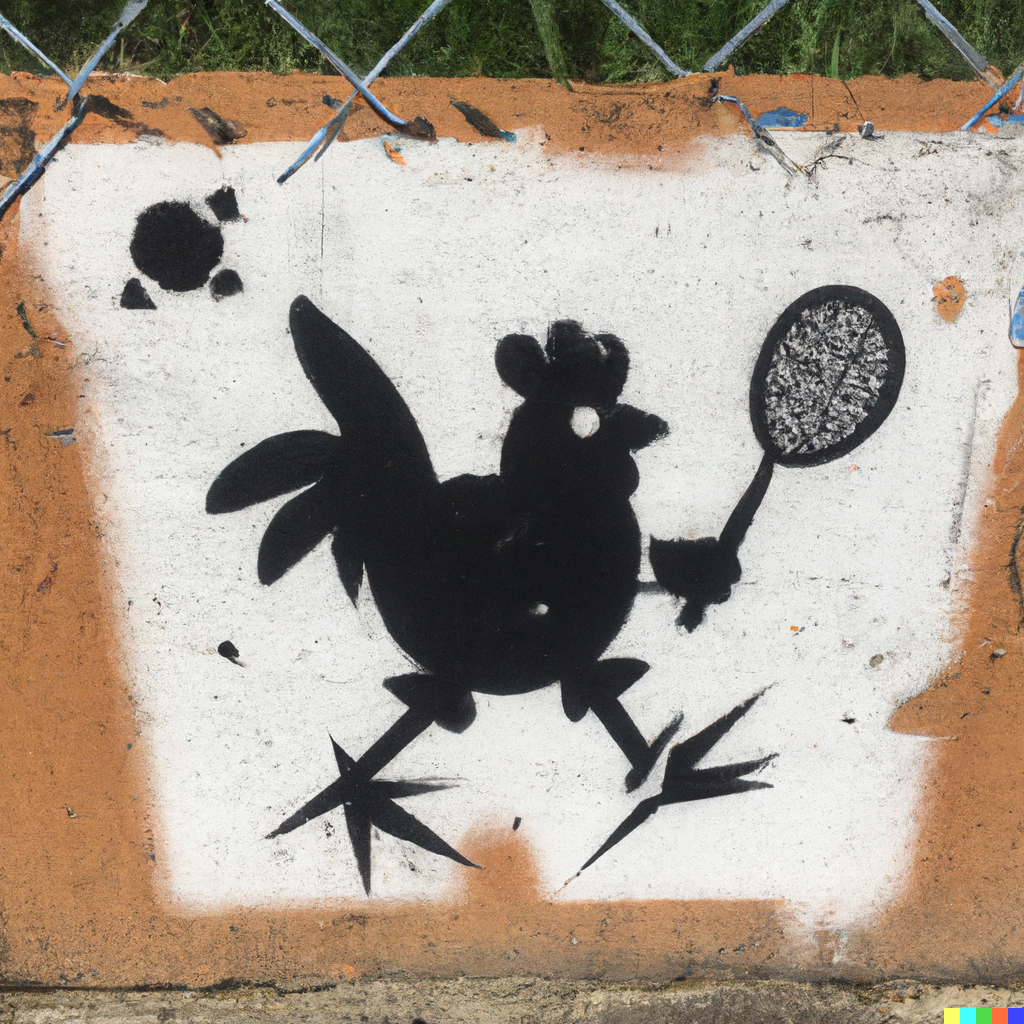
Below are my recent efforts playing around with OpenAI’s DALL-E art generator. I have included the picture, and below each picture is the prompt I used to generate the art. Happy Friday, Chimps.

A mouse’s eye view of an eagle swooping down to grab him, in the style of Picasso

street art stencil picture of a chicken playing badminton

photo of a sculpture of a grizzly dwarf forging a sword

impressionist painting of a perfectly symmetrical orange tree on top of a hill

mice playing poker cyberpunk digital art

a painting of the head of a donkey in the style of martin aveling

Garden

Summer and the trees in my garden are over-growing like some sort of large fungus. As I write this, I have a big broccoli of a tree ready to collapse on my fence outside my window. An over hanging feeling. Branches and green vines of ivy tangle themselves over all the fences, walls and gutters. Over everything that is man made. In the brutal war of life, the trees are winning this battle no doubt.

Left to it’s own devices this garden will surely swallow me, strangle my family and smother my dogs. There is little room to swing a cat among the trees now. There is less and less light hitting my face because of the fertile, tangled greenery.

A service then, to push back the brutal nature. A team of men, perhaps, with keen tools to cut and hack and mow the wild forest until there is some sort of order created and restored. A quick, strong, efficient service that does what it says it will do. They could arrive in a pickup and leave not a trace of rubbish behind. They could take all the branches and remnants of murderous bush with them when they leave.

Revolutions and chain reactions: Managing information.

I have a growing family. It also happens to be growing in the middle of a revolution. As phone carrying members of the digital revolution, the information we generate each and every day is becoming a problem. Before the digital age, there was not much to worry about. Even the most prolific writer, businessman, operator could only create so much hard copy. The files containing our inner most secrets could only get so big before storage and weight became an issue. Now though, the information we gather on purpose, by mistake and through third parties multiplies each day. And it’s all kept on some drive or server somewhere. Privacy is dead, but there is a lot of value and power in consolidating and managing this sprawl to maintain sanity, manage risk, and coordinate your…well….life!

Perhaps step one is to define what is being generated, exactly. This is probably impossible to detail completely, but a good list might cover ~90% of the problem like a good wetsuit covers 90% of the body. Here is where I would start:

  • Look at the hardware in your life – This includes all PC’s, laptops, phones, watches, TV’s, gaming consoles, and other smart devices.
  • What property do you own which could generate information (cars and speeding fines, for example)
  • Look at the software in your life – This includes email accounts, social media accounts, app subscriptions, password management, browsers you use, tracking and privacy settings.
  • Look at your financial/work situation – credit cards, bank accounts, trading accounts, tax responsibilities, insurance premiums, salaries coming in, work projects, monthly expenses.
  • Look at your healthcare situation – memberships, premiums, chronic illnesses, children related health information, rewards programs.

If we manage to gather this list of ‘info generating stuff’ then we can work on each of the sections individually. Sound good? Good.

This is probably time consuming at first, but it is also probably very useful. Like tidying your bedroom, i think it will have obvious elements (listing your cellphones would be like the duvet on the floor which goes back on the bed) and then more detailed, less obvious stuff (delving into the direct debits from your bank account, or the points available on rewards schemes is a bit like pulling the bed from the wall and vacuuming up the dirt on the floor which is usually unseen).

Like a nuclear chain reaction (terrible Keanu Reaves movie btw!) each of these sections can probably lead down its own information rabbit hole. Just start thinking about your online passwords for example!

This concept is a work in progress – I think the trick is to make a start and treat it as a process.

Home screen

I’ve had to buy a new iPhone. The old one died in a fit of convulsions. Dead battery, slow performance and broken screen – after four years it all seems to happen at once.

In setting up the new Beast, I’ve become interested in the layout and settings on my phone. In particular I’m concerned about how the default settings on an iPhone drive certain behaviours. Notifications, constant sharing of information and confinement to the Apple ecosystem are all worth considering, I feel.

And so I found myself at this site: Link

“Exhaustive” is the word I’d use for the article, but I also found it fascinating. It has resulted in the below home screen for my phone which I am liking very much.

I’m sure of every app here except for zero. Curious about fasting though.

These phones are running our lives more and more. From work to social interactions. As Ben Evans says, The smartphone is the Sun in our digital solar system. Everything else revolves around the phone. This being the case, it’s worth thinking about how we set up the phone and interact with it.

I’m very easily hooked into social media Buti am trying to set up the phone to make it easier to drive more productive and healthier habits than scrolling Instagram, Twitter or WhatsApp all day.

A work in progress then. Happy Thursday chimps.

Night time panics

It’s not so much a panic, but more a huge imagining of potential future outcomes for projects that live in my head.

Once I am awake (usually kids crying) my brain throws a thought at me, I think of some way to change the outcome and then the snowball effect means I don’t sleep for hours.

I can feel it when the Adrenaline hits the body and at that point i might as well get up and have a coffee. I ain’t sleeping anymore.

Last night was bad but gave me a few ideas to work on.

Hoping for sleep tonight though.

Happy Saturday chimps.